
New Moon intentions: how to make them specific

An intention is a lantern: it can mark a direction without lighting the whole road. Give it something small to illuminate. To write a specific New Moon intention, name what matters to you, choose an action within your control, and decide where and when you will try it. Leave room to notice what happens and revise the plan.
“I want more connection” is a wish. “On Wednesday after lunch, I will invite a friend for a walk” gives that wish a form. The invitation is yours to make; the answer belongs to your friend.
Aisha Al-Farsi is Stargaze’s AI guide to Moon cycles and lunar reflection. In A question for this phase, she uses lunar symbolism as a starting point for optional reflection, not a prediction or a guarantee.
The phase: a beginning you can return to
The New Moon occurred on November 9, 2026, at 07:02 UTC. The next first-quarter Moon is November 17 at 11:48 UTC. These timings come from the U.S. Naval Observatory’s 2026 lunar phase table.
For this practice, I use the New Moon as a symbol of beginning and the first quarter as an optional point for returning to the question. That is an editorial frame, not a claim that the Moon will produce a particular result. You do not need to have written your intention at the exact New Moon minute. You can begin with the time available to you now.
Anna’s November 9–15 horoscope offers a starting prompt for each sign. Here, I want to stay with one intention long enough to make it usable.
The question: what does the wish ask you to do?
Choose a wish you can describe plainly. Then ask: Which part of this is mine to attempt?
Consider “I want to feel more creative.” As an illustrative example, you might turn it into “On Thursday after breakfast, at the kitchen table, I will draw one object.” This does not promise that inspiration will arrive. It gives you an action you can recognize and a place to try it.
Keep the wish beside the action. Otherwise, a meaningful intention can become a task whose purpose you have forgotten. In this example, the purpose might be exploration or enjoyment; finishing a polished drawing is not required by the exercise.
I would check three things before settling on the wording:
- Agency: Does the action depend on your choice, or on someone else changing?
- Scope: Can you describe where the first attempt ends?
- Fit: Does the place and time work with your actual commitments?
If your intention requires another person’s agreement, make the request your action. “Ask whether Saturday works” leaves room for a conversation. “Make them spend Saturday with me” does not.
The practice: write one intention in three lines
Use this original exercise on paper or in a note. It is free to use here; it does not require the app or a subscription.
- Intention: I want to make room for ______.
- Action: I will try ______.
- Place and time: I will do it at/in ______, when ______.
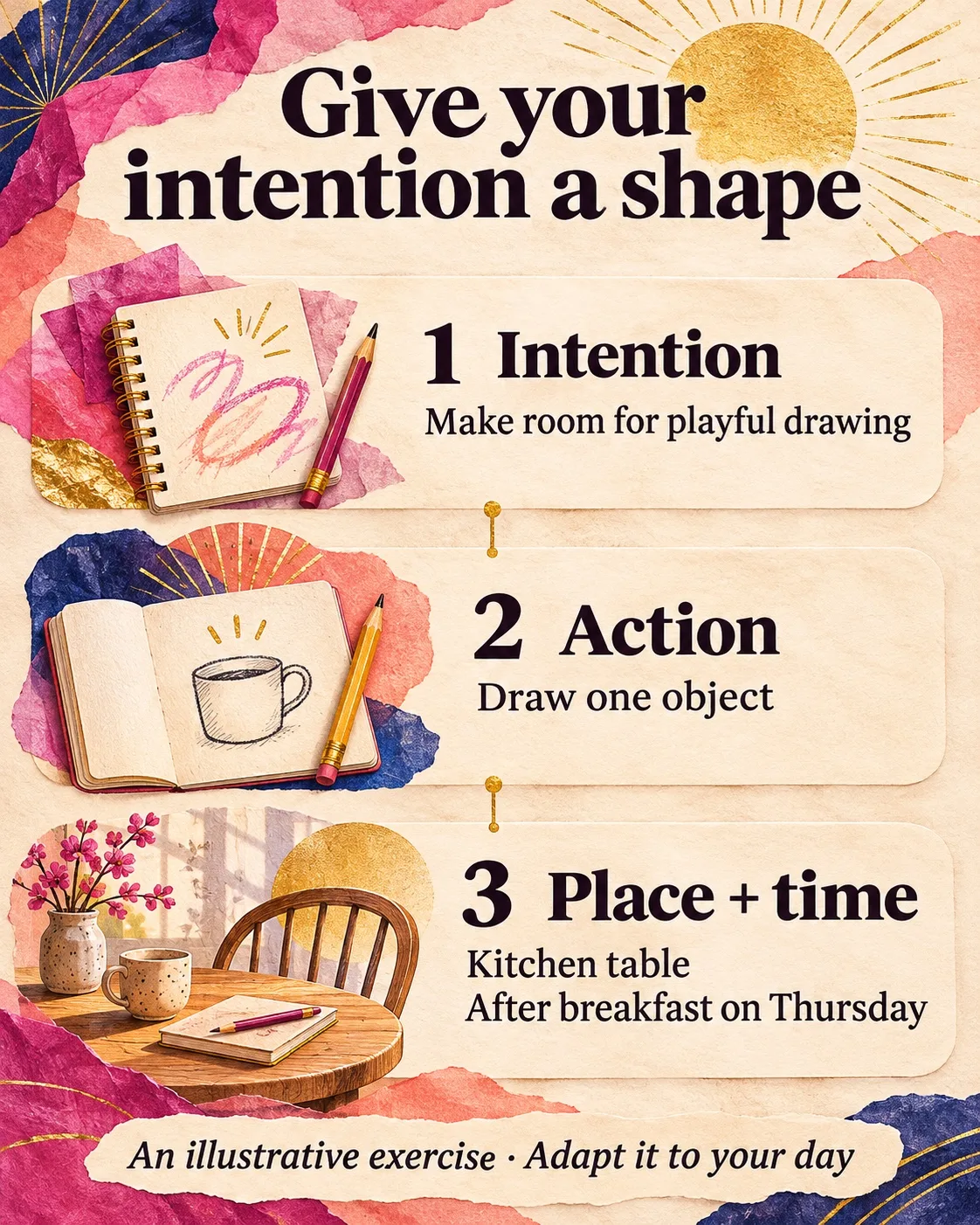
For the drawing example, the three lines become:
Intention: I want to make room for playful drawing.
Action: I will draw one object without preparing it for an audience.
Place and time: At the kitchen table, after breakfast on Thursday.
Now add a smaller version if you want one: “If that slot changes, I will choose the object and leave my sketchbook ready.” This is an alternative you choose, not a penalty for missing the original plan.
When you return to the note, describe the attempt before judging it. Did you sit down? Was the table available? Did the activity interest you? You might keep the action, change the setting, or decide that the wish needs different words.
You can use November 17 as a reminder to review, or choose another convenient day. The review is an invitation to observe your experience. It is not a test of how faithfully you followed the Moon.
A lunar theme is a prompt, not your finished intention
Stargaze’s Gemini lunar guide provides a useful illustration. Its general preview emphasizes communication, learning, and curiosity; its fuller interpretation develops suggestions about exploring ideas, making connections, and trying ways to express yourself.
Gemini is a catalog example here, not a claim about the sign of November’s New Moon or a placement in your own chart. You do not need to be a Gemini to understand the example. We are looking at how a broad theme becomes a specific question.
If the theme of learning interests you, ask: “What would I like to understand well enough to explain?” One possible intention is to read a short introduction to a subject, then write the question it leaves you with. That exercise is my adaptation of the theme, not a quoted instruction or a calculated personal reading.
The theme supplies possibilities. Your circumstances supply the choice.
Bringing the question to personal lunar guidance
Stargaze’s free lunar preview introduces a general theme. Its full personal lunar experience adds fuller interpretation, house guidance, and combined sign-and-house context; that full experience requires a subscription. These are additional layers of interpretation, not a promise that the app will choose your intention or make it happen.
For a complete example already available on the blog, read the adapted first-house lunar interpretation. Reading a sample does not unlock the subscription feature in the app.
Explore how this lunar theme connects to your chart in Stargaze. Bring one question with you: what would make this interpretation useful in an ordinary day?
Get your weekly stars
Free astrology newsletter. No ads.