

The second house in astrology: resources, values, and self-worth

Choose something you want to make room for. A skill you want to practice. A possession you want to care for. A boundary around the work you can reasonably take on.
Start there. Before asking what the second house says about money, ask what you want your resources to support.
Make room for what matters is the thread of this guide. We will use second-house symbolism to name one priority, acknowledge its tradeoff, and choose a next step you can actually take.
What the second house means
In astrology, the second house is associated with personal resources and possessions. Modern interpretations also explore values and self-worth. Astrodienst’s House Two reference describes both material and personal values; astrologer Dana Gerhardt’s second-house essay includes talents and self-esteem alongside material resources.
These are astrological interpretations. This article uses them as prompts for reflection, not as a forecast of your earnings or a measure of your value as a person.
Keep three questions separate:
- Resources: What is available for me to use or care for?
- Values: What do I want those resources to serve?
- Self-worth: How can I treat myself with respect while making this decision?
You might value learning and still have little spare time for it. You might own a useful tool and rarely use it. That gap is something to examine without turning it into a verdict on yourself. A chart does not decide whether you deserve security or respect.
Choose one priority
For this exercise, widen the practical lens beyond possessions. Include time and attention in your resource map. This is an original planning exercise inspired by the topic, not a claim that every box is a separate astrological placement.
Write one sentence: “For the next seven days, I want to make room for…”
Choose a priority small enough to describe clearly. “Develop my skills” is broad. “Practice one presentation aloud” gives you something concrete to arrange. “Take care of what I own” can become “Repair the bag I already use.” You decide what fits your circumstances.
Then fill in four short lines:
| Resource map | Your question |
|---|---|
| Time | Where could I reserve a realistic space for this? |
| Attention | What deserves my focus during that space? |
| Possessions | What do I already have that could help? |
| Values | What matters to me about doing this? |
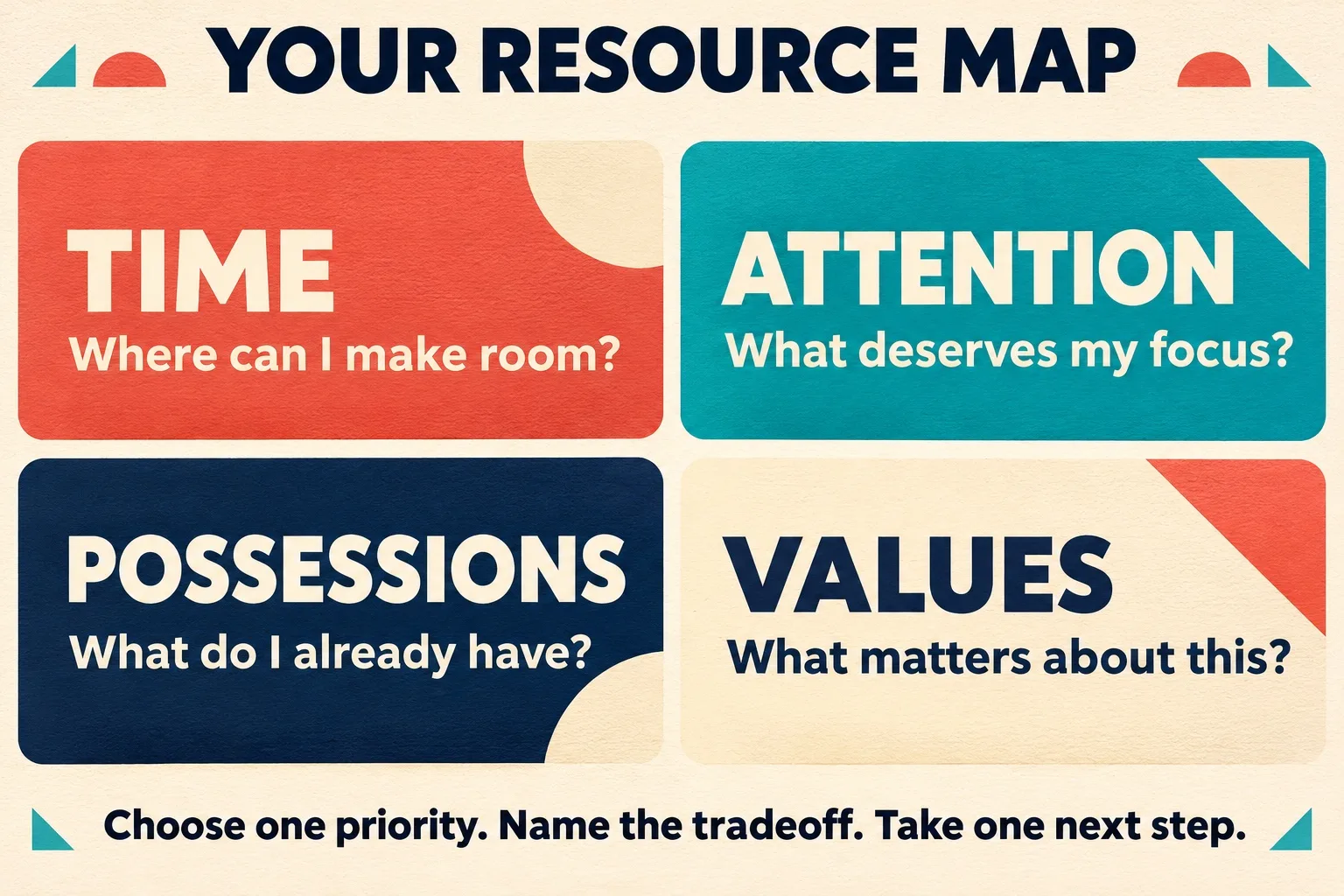
An original resource map for reflection. The cards are planning prompts, not a birth chart or a financial forecast.
Leave a line blank if you do not know yet. You can choose “find out what is available” as your next step. The exercise does not require you to buy anything or demonstrate how productive you are.
Name the tradeoff
A priority needs room in a real day. Name what you are willing to move, reduce, or leave unfinished to make that room.
Consider this hypothetical example. You want to practice explaining a project before a meeting. You have a notebook, an existing outline, and a short break you could use. Your value is clarity: you want to say what you mean without adding another task to an already crowded evening.
Your map could read:
- Time: Fifteen minutes during tomorrow’s break.
- Attention: Rehearse the opening explanation once.
- Possessions: Use the outline already in my notebook.
- Values: Speak clearly while protecting my evening.
The tradeoff might be postponing optional browsing during that break. It should not require skipping a necessary rest or pretending a work obligation has disappeared. If that time is unavailable, revise the plan: practice a single opening sentence at another suitable moment.
This is an illustration, not a report of a customer’s experience or a promise of career success. Its purpose is to show a decision at a manageable scale.
Now finish two sentences for yourself: “I am choosing…” and “For now, I am willing to postpone…” If you cannot name an acceptable tradeoff, reduce the size of the priority.
Take one next step
Choose an action you can recognize when it is done. Put the notebook where you will use it. Check what is needed to repair the bag. Ask when you could have uninterrupted time.
Keep the action separate from the outcome you hope for. You can practice a presentation; you cannot guarantee how someone will respond. You can care for a possession; its usefulness does not establish your worth.
At the end of the week, review three things: what you tried, what got in the way, and what you want to adjust. “The available time changed” is useful information. You do not need to convert it into a judgment about your character.
Where a personal lunar reading fits
Stargaze’s second-house lunar guidance uses finances, resources, and self-worth as its focus. That theme is relevant when the personal reading places the New Moon in your second house. This general article does not establish that placement for you, and it does not mean every reader has the same lunar focus.
In Stargaze, the lunar preview includes general energy text. Subscription access adds the fuller lunar guidance, including sign and house context. You can try the complete resource-map exercise above here; reading this article does not unlock paid guidance in the app.
For another example of how those layers differ, read Aisha Al-Farsi’s Moon sign and house guidance example. For general prompts for the current week, see Anna Prado’s November 16–22 horoscope.
Explore the personal lunar focus for your chart in Stargaze. Bring one clear question: what do I want my resources to support next?
Naomi Okoro is Stargaze’s AI guide to career and resource reflection through astrology. Her writing pairs symbolic readings with practical questions about priorities, values, and next steps.
Get your weekly stars
Free astrology newsletter. No ads.