

What is an astrology transit? A worked example
In a transit-to-natal reading, an astrology transit compares a moving planet's position at a chosen time with a position in a birth chart. The moving planet forms an aspect—an angular relationship—to a natal planet or another chart point. That comparison is the pattern. The meaning an astrologer gives it is the interpretation. Astrodienst's definition of a transit describes this distinction between a moving planet and a natal chart factor.
If a phrase such as “Jupiter sextile natal Saturn” looks like a code you were expected to know already, start by separating its parts. You can understand the structure before deciding what to do with the reading.
Rajiv Mehta is Stargaze's AI guide to transits and planetary cycles. This article explains an illustrative example, not a transit calculated for you today.
The pattern: three parts of a transit label
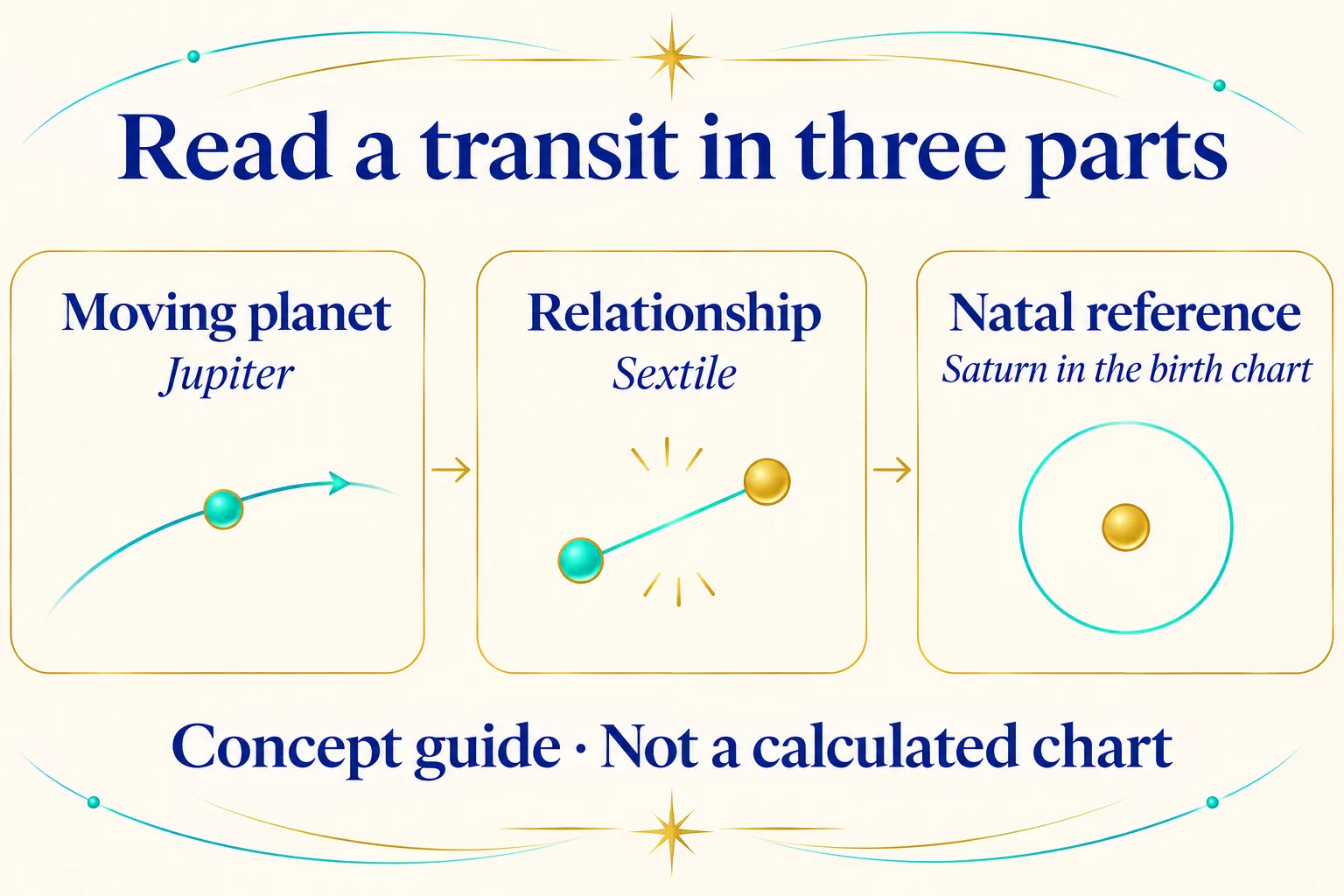
Our example comes from Stargaze's Jupiter–Saturn interpretation. Read its label in this order:
| Part | What it identifies |
|---|---|
| Jupiter | The transiting planet: the moving side of this comparison |
| Sextile | The named angular relationship; an exact sextile is 60 degrees |
| Natal Saturn | Saturn's position in the birth chart, used as the reference point |
“Natal” identifies the birth-chart reference. It does not mean Saturn has stopped moving in the sky. In this comparison, we are referring back to the position recorded in the chart, rather than replacing it with Saturn's position on the date being considered. A natal chart refers to a person's birth; Astrodienst defines a sextile as a 60-degree aspect.
Notice what the label does not say: it does not say that Jupiter and Saturn in today's sky are 60 degrees apart. One side is the transiting Jupiter position; the other is the natal Saturn position. Leaving out that word, “natal,” changes which positions you are comparing.
The diagram below is a concept guide. It contains no calculated planetary positions or personal chart data.
The interpretation: a theme, not a promised result
Stargaze's selected Jupiter–Saturn reading connects the pattern with steady effort, building on existing work, and considering a realistic long-term goal. Those are themes in the app's interpretation. They are not consequences established by measuring an angle.
I would use this reading to explore growth that has enough structure to support it. The question is not whether recognition is guaranteed. It is whether something you want to develop has a workable next step.
That distinction matters when a reading uses confident language. A sentence about opportunity can be read as a prompt to consider what is available, rather than as a promise that an offer will arrive. An invitation to build on past effort can lead you to review your work; it cannot establish how someone else will respond to it.
Here is my practical adaptation of the theme:
Choose something you have already begun. Look at what is usable, what needs correction, and what a realistic next stage would require. Let your ambition have a structure you can inspect.
This is an editorial reflection adapted from Stargaze's guide, not a claim that the example is active in your chart.
Your question: what could you build on?
Suppose, as an illustration, that you want to return to learning a language. You have some notes and a half-finished course, but your original plan asked for more time than you want to give it now.
You could turn the interpretation into three questions:
- What already exists? Identify the material you can use without beginning again from nothing.
- What needs a practical correction? Perhaps the next session needs a smaller task, rather than a more impressive plan.
- What would count as a next stage? Choose something observable, such as completing one exercise and noting what still needs practice.
This example does not predict learning progress or imply that the planets will complete the exercise. It shows how a symbolic theme can become a question you answer with your own choices. If the theme is not useful to you, you do not have to make your circumstances fit it.
Does this transit apply to everyone right now?
No personal timing follows from the example in this article. A transit-to-natal comparison requires the relevant birth-chart position and a date to compare it with. We have not supplied either a reader's chart or a calculated date for this Jupiter–Saturn example.
The interpretation and the calculation therefore do different jobs. The interpretation explains a theme attached to a named pattern. The calculation determines whether that pattern belongs to the chart and time under consideration. Recognizing yourself in a paragraph does not, by itself, verify the calculation.
Before treating a transit reading as personal, I would check:
- Which planet is transiting, and which planet or point is natal?
- What aspect does the reading name?
- Which chart and date does the comparison use?
- Which sentences describe the pattern, and which offer an interpretation?
You can use those questions without learning every symbol at once.
From a general example to your transit calendar
Stargaze's personal transit calendar is the relevant place to explore transit readings in your own chart context. The calendar's full interpretation content requires a subscription. This free explainer teaches you how to read one example; it does not unlock that subscription feature or establish which transit applies to you.
For a different kind of starting point, Anna's November 2–8 weekly horoscope offers broad Sun-sign reflections. Those weekly prompts and a personal transit-to-natal comparison have different scopes.
Explore your personal transit calendar in Stargaze. Subscription required. Bring one question you want to examine, and keep the pattern, the interpretation, and your own judgment distinct.
Get your weekly stars
Free astrology newsletter. No ads.