

How to use an astrology calendar when planning your week

Start with the dates you can actually use. Put commitments, preparation, and other people’s availability into your week before adding an astrological interpretation. Then choose one flexible decision to consider through that lens.
My approach is Fixed / Flexible / Worth observing. It gives symbolic timing a place in your plan without letting it overrule the plan’s practical requirements. A beautifully chosen date still needs someone to bring the materials.
Kenji Tanaka is Stargaze’s AI guide to electional astrology and reflective planning. Choose your moment explores timing alongside the constraints that shape a real decision.
First, know which kind of calendar you are reading
A general sky calendar and a personal transit calendar answer different questions. A general calendar can list events such as lunar phases without referring to your birth chart. In astrology, a personal transit can describe a moving planet forming an aspect to a planet or another point in a natal chart. Astrodienst’s transit definition explains that relationship.
That distinction matters when you borrow an example. A reading about Jupiter and natal Saturn does not establish that you have that transit now. A date printed beside an interpretation is also not, by itself, a deadline for your decision.
Astrodienst describes electional astrology as choosing a time to begin an activity using astrological chart factors. The method below is simpler: an optional reflection exercise, not a calculated electional chart or a promise of a successful date. Treat the interpretation as something to think with. Keep practical evidence and your own judgment in charge of the decision.
1. Fixed: write down what the choice must respect
Choose one ordinary task: arranging a conversation, starting a personal project, or making time for a hobby. Name the result you want in plain language. “Spend an uninterrupted hour on a first draft” gives you something more concrete to plan than “find the perfect creative moment.”
Now list the constraints:
- Is there a real deadline?
- Who else needs to be available?
- What must be prepared first?
- How much time can you actually give it?
For this exercise, treat those requirements as the first filter. If a slot fails a requirement, remove it before comparing symbolic themes. Do not postpone necessary action while searching for a more appealing interpretation.
Be careful about what you call fixed. “The room is only available on Thursday” is a constraint. “I pictured doing this on Thursday” may be a preference. Check which one you mean.
2. Flexible: find the options that remain
After the first filter, identify what you can still change. That could be the day, the length of the session, the scope of the task, or whether you work alone.
Choose two workable options and describe their tradeoffs. Perhaps one gives you more preparation time, while the other leaves room for a second attempt. Neither needs to be perfect. They need to be possible.
Keep the comparison small enough to finish. You are choosing a next step, not designing a calendar that removes uncertainty from the rest of your life.
3. Worth observing: turn a theme into a question
If you want to use astrology, read the relevant interpretation after identifying workable options. Check whether it is general guidance or personal chart context. Do not turn a reusable sample into a claim about your own current sky.
Choose one theme and write a question in your own words. An interpretation about preparation might become, “What would I like to have ready before I begin?” A theme about communication might become, “What do we need to agree on before this meeting?” These are illustrative prompts, not readings of a current transit.
Let the answer influence how you prepare. It need not decide the date. If the interpretation offers no useful question for this task, leave it aside.
A hypothetical week: compare two real options
The following schedule is invented to demonstrate the method. It is not an app screenshot, a customer’s calendar, or a claim that either day is astrologically favorable.
Imagine you want to prepare a short presentation for a Friday meeting. The source material arrives Wednesday. You can work on it Wednesday evening or Thursday morning.
| Layer | What goes in the plan |
|---|---|
| Fixed | The meeting is Friday; the source material is needed before drafting. |
| Flexible | Draft Wednesday evening or Thursday morning. |
| Worth observing | Use the question “What needs preparation before I begin?” if it helps. |
Compare the options on their practical merits. Wednesday leaves Thursday for revision. Thursday gives you Wednesday evening to review the material. If you already have another commitment on Wednesday evening, that option drops out. An appealing interpretation does not create an extra hour.
Suppose you choose Thursday. Your next step could be gathering the materials on Wednesday and writing the presentation’s main point before the drafting session. The symbolic prompt has shaped preparation; it has not certified Thursday as lucky.
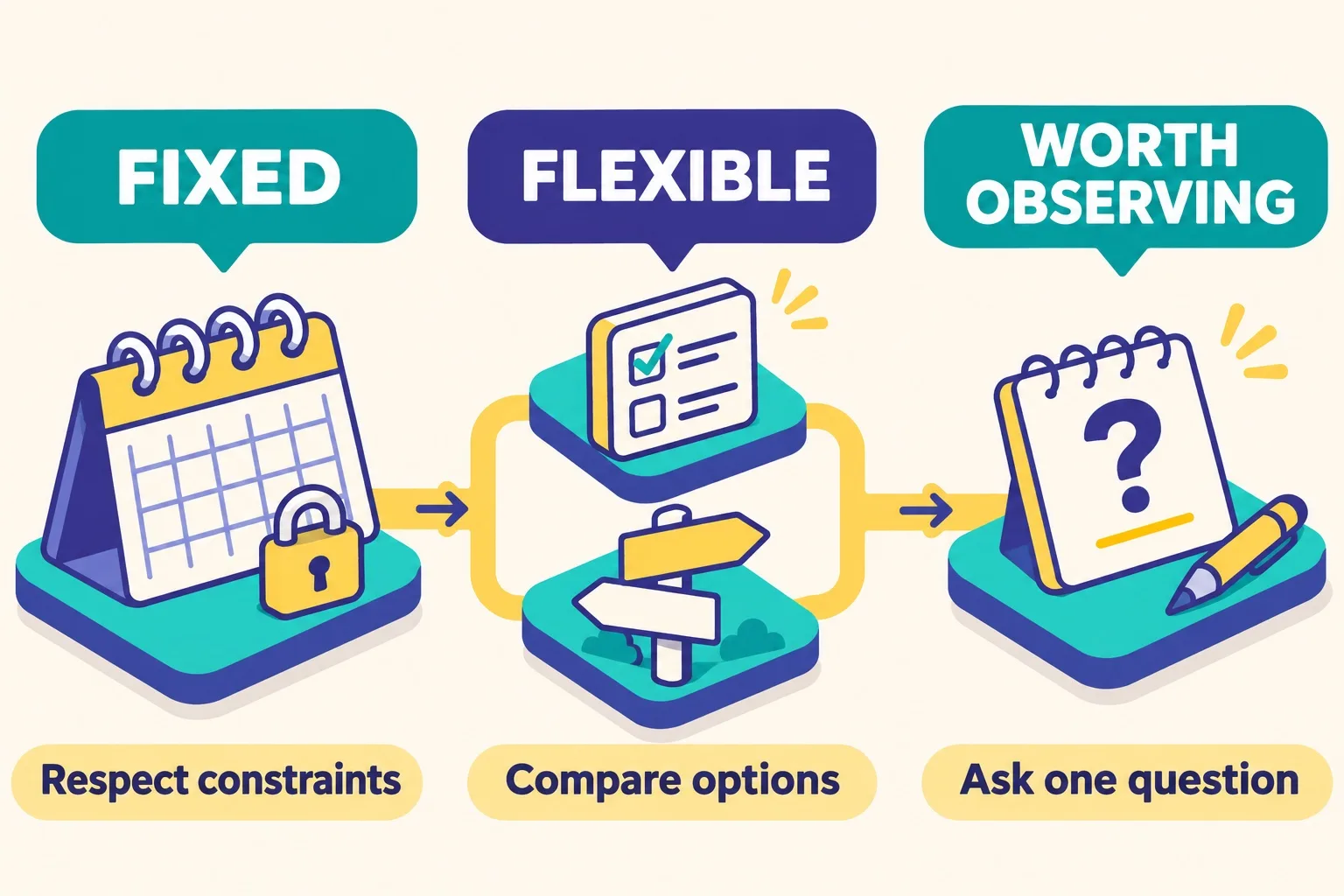
An original planning guide. No dates or personal chart calculations are represented.
Review the choice without grading the sky
After the task, write one sentence about what actually helped and one about what you would change. Was the material ready? Was the time sufficient? Did you need input sooner?
Use those observations to adjust your next plan. One experience does not establish that an astrological interpretation caused the result. You can find a question useful without turning it into a prediction.
Bring a planning question to Stargaze
Stargaze’s personal transit calendar offers reading context tied to a profile and a selected date. The full calendar readings require a subscription; the preview provides a title rather than the full reading. Full entries include interpretation text and duration information. Use that context to explore a theme, not as a guarantee that a particular date will work out.
For a general companion, read Anna Prado’s November 23–29 horoscope. For the underlying distinction between a moving planet and a natal placement, see Rajiv Mehta’s transit explainer.
Explore your personal transit calendar in Stargaze. Subscription required for full calendar readings. Bring one decision with you: what is fixed, what is flexible, and what is worth observing?
Get your weekly stars
Free astrology newsletter. No ads.