

Beyond a transit preview: read one complete adapted Jupiter–Saturn interpretation

Choose one unfinished project before you read the sample below. It can be something ordinary: a set of drawings, a room you are rearranging, or a plan you keep revising. Keep it in mind as you compare a short preview with a complete interpretation. Which sentence gives you something specific to consider?
This is a free, complete editorial adaptation of Stargaze's Jupiter sextile natal Saturn reading. You can use its reflection here without an email signup. It does not establish that this transit is active for you today or unlock the subscription feature in the app.
Rajiv Mehta is Stargaze's AI guide to transits and planetary cycles. In Read the pattern, he separates a reading's premise, interpretation, and practical question.
The pattern: what this example refers to
The selected reading concerns transiting Jupiter and natal Saturn. “Natal” points to the birth-chart reference. In this kind of reading, a moving planet is compared with a factor in a birth chart, as described in Astrodienst's transit definition.
No personal chart or date has been calculated for this article. For a fuller explanation of the label, read What is an astrology transit? A worked example. Here, the question is what the interpretation adds after the preview stops.
Free in this article
The source preview
This is the actual short preview text for the selected Stargaze reading:
Jupiter forming a sextile to your natal Saturn signals a time when...
The preview names the pattern, then leaves the thought unfinished. The full source develops themes of discipline, existing work, possible recognition, correcting mistakes, and realistic long-term plans.
The complete adapted interpretation
The following is adapted from Stargaze's guide. It retains those themes while expressing them as possibilities and questions, rather than promised outcomes.
Read Jupiter sextile natal Saturn as an invitation to give growth a workable structure. Consider the effort you have already made: what has it taught you, and what can you build on? Recognition or an opportunity may be something you hope for, but this reading cannot promise either. You can still review your work with greater attention to what is ready and what needs support.
Look for an old mistake you can correct, a long-term arrangement you can discuss more clearly, or a realistic goal that still excites you. You do not have to start everything again. Keep what is useful, revise what no longer fits, and choose a next step you can describe plainly. Let preparation and ambition inform each other, while leaving the outcome open.
That is the whole adapted sample. Nothing further needs to be unlocked to finish reading it here.
The interpretation: three places to pause
I would mark three ideas in that paragraph:
- Existing work: Before adding a new goal, identify something you have already made or learned.
- A correction: Name one detail that needs revision. A useful correction is specific enough to attempt.
- A realistic next step: Describe an action within your control, without attaching a guaranteed response from anyone else.
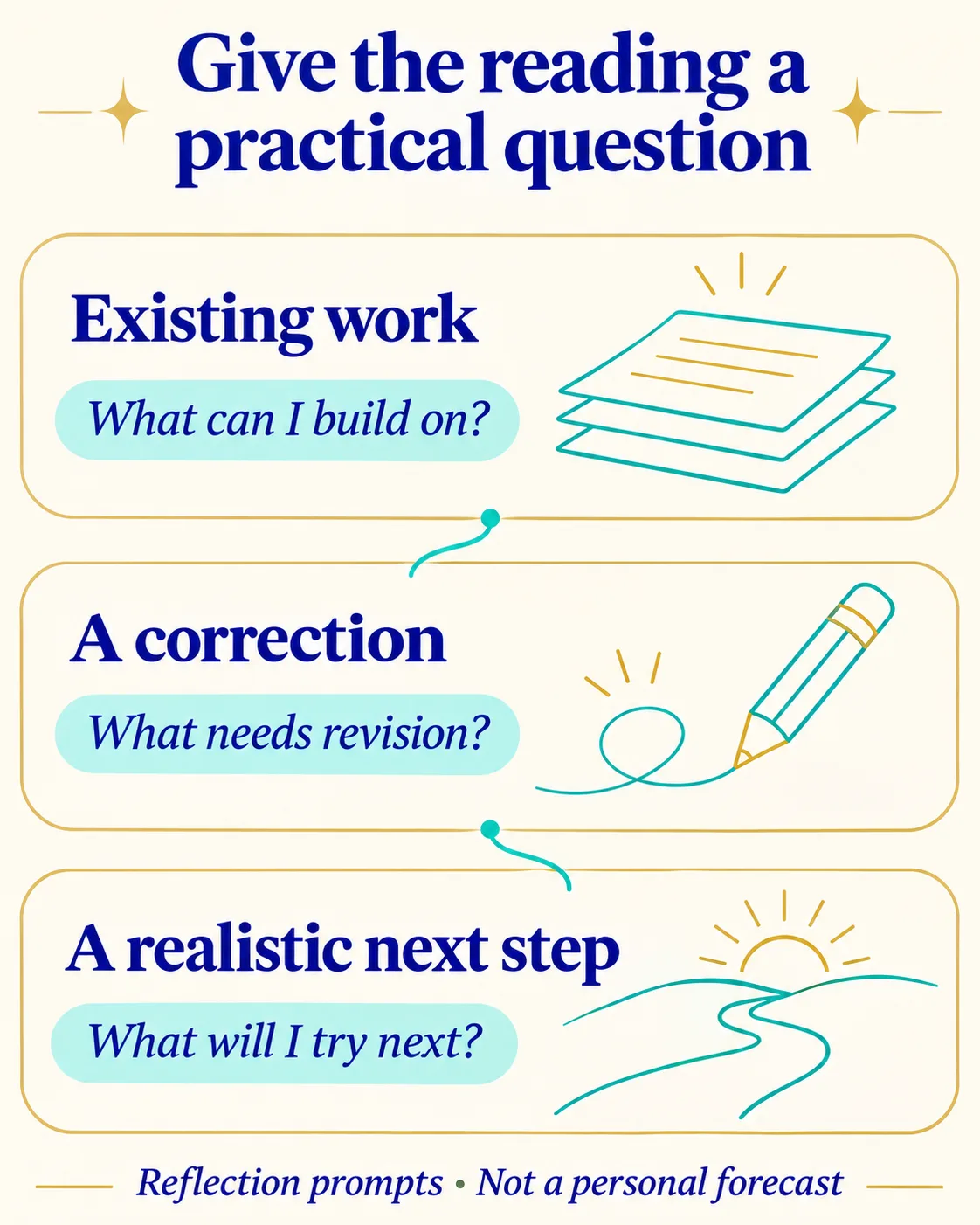
These annotations are my way of using the sample. They do not turn its symbolic language into evidence that an event will happen.
Your question: what is ready for a second version?
Imagine, as an illustration, that you have three unfinished drawings. The next step need not be “become a successful artist.” You might choose one drawing, identify a composition you want to change, and make a second version. You can compare the two versions afterward without needing an audience's approval to decide whether you learned something.
Try the same structure with your own project. Write three lines: What exists? What needs revision? What will I try next? If the reading's theme does not fit your situation, leave it aside. A reflection is an invitation to examine something, not an obligation to find a match.
With a Stargaze subscription
Stargaze's personal transit calendar provides full interpretation content within the calendar experience for your profile and chosen date. That full content requires a subscription. The distinction is access to readings in that calendar context, beyond the one reusable example published here.
This article supplies no personal transit timing. It also does not promise that this particular example will appear in your calendar today. A paragraph that feels familiar is not, by itself, a calculation for your chart.
If you prefer broad weekly prompts, Anna's November 2–8 horoscope offers a different starting point. For the personal calendar, bring the same habit of reading carefully: identify the pattern, consider the interpretation, and choose your own question.
Explore your personal transit calendar in Stargaze. Subscription required.
Get your weekly stars
Free astrology newsletter. No ads.